AAC in Classroom Management and Daily Routines
AAC in Classroom Management and Daily Routines
Contur secțiune
-
MODULE 8
AAC in Classroom Management and Daily Routines
The introduction of this program stems from the understanding that communication is not simply a skill, but a universal human right and the fundamental key to self-determination. Designing an intervention based on Augmentative and Alternative Communication (AAC) therefore means embracing a true mindset that transforms traditional teaching into truly inclusive planning.
The starting point is to move beyond the purely clinical model in favor of a social model, in which difficulty is not seen as an individual limitation, but rather as the result of the gap between their abilities and the demands of the environment. From this perspective, AAC is not a posthumous adaptation for an individual student, but a facilitating mediator for the entire class, aimed at breaking down cognitive and communication barriers from the very beginning of the lesson. Through the use of international standards such as ARASAAC or METACOM, the goal is to create a "speaking context": an environment where cognitive load is optimized and all information becomes decodable, allowing the student to move from passive reception to active and informed participation.
1. Educational Objectives: Towards a Universal Design
The first fundamental objective of this module lies in the ability to transform traditional instructional design into a truly inclusive one , one that goes beyond the posthumous adaptation of a lesson, but integrates Augmentative and Alternative Communication (AAC) from its inception. Educators and teachers must acquire a mindset capable of viewing symbols and visual aids not as special tools for an individual student, but as facilitators for the entire class. Designing a lesson using AAC means, first and foremost, breaking down the communicative and cognitive barriers that impede access to content, ensuring that every student, regardless of their verbal abilities, can actively participate in the construction of knowledge.
A second crucial training goal concerns the development of skills in the differentiated adaptation of materials . There is no single way to teach AAC; the training aims to provide teachers with the critical tools to tailor teaching interventions to the student's specific profile. The focus will shift from analyzing mild or moderate clinical conditions—where symbols support the understanding of abstract concepts and sentence structure—to severe or profound disabilities. In the latter case, the focus shifts toward sensory stimulation, basic spatial-temporal orientation, and the creation of minimal but meaningful communication contexts, focused on well-being and reducing frustration resulting from the inability to express oneself.
Furthermore, the module aims to provide participants with mastery of international visual communication standards . Learning to properly use pictogram sets (such as ARASAAC or METACOM) isn't just about "putting pictures" on a sheet of paper, but also about understanding visual syntax: the spatial arrangement of symbols, color coherence, and information hierarchy. This allows for lessons that optimize cognitive load, allowing students to focus on the learning content rather than struggling to decipher the communicative medium.
Finally, a cross-cutting but primary objective is the promotion of self-determination and social participation . AAC lessons should not be passive, receptive learning, but rather an opportunity for students to learn to make choices, express preferences, and interact with peers. The educational goal is therefore to teach teachers how to structure the school environment so that it becomes a "speaking context": from wall labels to visual timetables, every element must contribute to making students a conscious protagonist of their own school day. From this perspective, AAC becomes the "bridge" mentioned in the materials, transforming isolation into connection and dependence on adults into progressive communicative and decision-making autonomy.
2. Short Theoretical Part
Augmentative and Alternative Communication is not a simple technique, but a clinical and pedagogical approach . It is defined as:
-
Augmentative: because it increases and enhances existing natural language.
-
Alternative: because it provides different modalities (signs, symbols, technological aids) when verbal language is not functional or is absent.
The project aims to ensure the right to communication as a fundamental tool for self-determination and social inclusion. Specifically:
-
Reduce frustration resulting from the inability to express needs and desires.
-
Develop relational and social skills.
-
Support learning and participation in everyday life contexts (school, family, leisure time).
A key point of the document is that AAC is not just about the individual, but involves the entire ecosystem of life . The involvement of "communication partners" (parents, teachers, educators) is essential, as they must learn to use these tools to create a truly accessible environment.
Designing a lesson based on Augmentative and Alternative Communication (AAC) cannot ignore a solid theoretical foundation that views communication as a universal human right and cognitive accessibility as the key to exercising it. As highlighted in the reference materials, accessibility is not just about removing architectural barriers, but about creating an environment where information is decodable by anyone. In this sense, the theory underlying AAC is based on the shift from a purely clinical model to a social and inclusive one , where the difficulty lies not only with the individual, but in the gap between their abilities and the demands of the surrounding environment.
A fundamental theoretical pillar is Visual Style . Many students with complex communication needs process information more effectively through the visual channel than through the auditory one. The theory teaches us that the graphic symbol (pictogram) acts as a conceptual "anchor": while the spoken word is transitory and evanescent, the symbol persists in time and space, reducing the load on working memory and allowing the student to process the message at their own pace. This approach requires a thorough knowledge of symbolic systems (such as ARASAAC or METACOM ) and their syntactic rules: the theory of sentence construction in AAC follows a rigorous logical sequence (Subject-Verb-Complement) to ensure that the message is unambiguous and unambiguous.
In addition to iconic support, inclusive teaching theory emphasizes structuring the environment and time . Based on the concept of "accessible context," the theory suggests that an effective lesson begins long before the explanation: it involves the use of visual agendas and symbolic timetables that allow for the predictability of events. The ability to predict what will happen dramatically reduces anxiety and problem behaviors, promoting the state of emotional well-being necessary for all learning.
Finally, the theoretical framework of this module addresses the distinction between the different levels of support needed. It is not designed the same way for a mild disability as for a severe or profound disability . While in the former case the theory focuses on vocabulary expansion and academic participation, in more complex cases the communication theory shifts toward " pre -intentional communication," where the goal is to interpret body signals and micromovements to build meaningful interaction. In short, the AAC theory in this module is not a rigid doctrine, but a flexible framework that aims to build that "communicative bridge" capable of transforming the frustration of isolation into the gratification of active participation and self-determination.
3. Practical Activities and Examples
Sara's Game. The "Sara's Game" Learning Unit represents a paradigm shift in inclusive education, transforming inclusion from a simple theoretical concept to a playful, concrete, and collaborative experience. At the heart of this initiative is total collaboration , a model in which the barriers between support and curricular teaching dissolve, creating a cohesive learning community. In this context, support and curricular teachers work in synergy with the OEPAC, engaging not only the class group, but the entire school community in a mutual learning process that aims to break down communication barriers.
The program unfolds through the intersection of various disciplines, each of which contributes fundamentally to the project. In Italian , the focus is on enhancing native language skills, using Augmentative and Alternative Communication (AAC) as a tool to enrich vocabulary and facilitate storytelling, allowing each student to express their inner world. Technology acts as a facilitator, providing software and digital tools that make content accessible and enable the creation of personalized teaching materials, such as communication charts and digital books. Finally, Civic Education provides a framework of values, promoting active citizenship and respect for diversity as a common resource, in line with the universal right to cognitive accessibility.
The transversal skills that students develop along this path are multiple and profound. Central to this is the ability to collaborate and participate , learning that achieving a common goal is possible only through listening and contributing from everyone. At the same time, the project fosters a desire to learn how to learn , encouraging students to develop independent and flexible learning strategies that can adapt to different contexts.
Operational Phases and Methodology
From an operational point of view, the UDA is divided into three dynamic macro-phases, designed to ensure the success of each participant:
-
Design and Adaptation Phase: In this stage, the class collaborates on creating AAC materials. This involves not only producing cards, but also building the game tools (rules, scoreboards, cards) using ARASAAC or METACOM symbols, ensuring that the syntax is correct and accessible to all.
-
Rewards and Recognition Creation Phase: To enhance participation and commitment, "inclusive rewards" are designed that do not celebrate absolute performance, but rather individual contribution and the ability to support teammates, strengthening self-esteem and a sense of belonging.
-
Performance and Monitoring Phase: During the actual game, teachers continuously monitor the children. Observation focuses not only on compliance with the rules, but also on the effectiveness of communication mediated by symbols and the fluidity of social interactions.
Evaluation and the "Six Thinking Hats" Method
Evaluation and Self-Evaluation phase , which transcends the numerical grade. Using De Bono's Six Hats technique , students and teachers analyze the experience from six different perspectives:
-
White Hat (Facts): Analysis of objective data (what did we do? what tools did we use?).
-
Red Hat (Emotions): Expression of feelings experienced during the game (did I feel included? did I feel frustrated?).
-
Black Hat (Critical Issues): Identifying difficulties encountered and obstacles to communication.
-
Yellow Hat (Positive Aspects): Reflection on the benefits obtained and the strengths of the group.
-
Green Hat (Innovation): Brainstorming how to improve the game or apply AAC in other moments of school life.
-
Blue Hat (Organization): Final summary and planning of next steps to make inclusion a daily practice.
In this way, "Sara's Game" is not just an educational activity, but a true "bridge" that connects people, transforming the classroom into a laboratory of humanity, where every voice—symbolic or verbal—has the same weight and dignity.
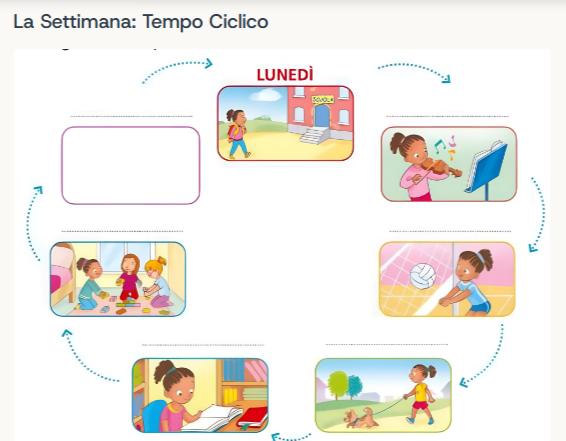
The Wheel of the Week. The goal of this activity is to make the cyclical nature of time tangible, helping students predict events and reduce anxiety about uncertainty through constant visual support.
1. The Tool: The Circular Calendar
Instead of a vertical list, we'll use a color wheel divided into seven segments. Each segment represents a day of the week and is associated with:
-
A Specific Color: (e.g. Monday = Yellow, Tuesday = Pink, etc.).
-
An ARASAAC Pictogram: Which identifies the name of the day.
-
School Routine: A symbol representing the main activity of that day (e.g., Gymnastics, Music, Lunch).
2. Daily Activity: "Who are we today?"
Every morning, during "Circle Time", the student (or in turn with classmates) performs a physical action on the wheel:
-
Move Arrow: The student moves a movable arrow to the current day.
-
Yesterday/Today/Tomorrow Association: Using a dedicated communication table, construct the sentence:
Subject (Today) + Verb (is) + Complement (Tuesday)
-
Prediction: "If today is Tuesday and there is a Gym pictogram , then I am wearing a tracksuit today."
-
Level Adjustments:
Mild/Moderate Level: The student completes a sheet where he must glue the missing days following the correct logical sequence.
-
Severe Level: The teacher uses real objects (e.g., the ball for gym day) paired with the symbol on the wheel to reinforce the connection between time and activity.
-
Deep Level: The focus is on sensory stimulation associated with the "color of the day" (e.g. wearing a ribbon of the color corresponding to the segment of the wheel).
4. The Bond with the Family
To ensure continuity (as required by the module's structure), families receive a smaller version of the "Wheel" to hang in their bedrooms. This way, students find the same visual code and logical sequence learned at school at home, facilitating self-determination even in their domestic routines.
Inside & Outside: Exploring Boundaries. The acquisition of spatial relationships is not just a mathematical or psychomotor goal, but represents a fundamental step towards cognitive accessibility . Understanding where objects and people are located in space allows students to logically order the world, reducing uncertainty and promoting self-determination. In an AAC context, concepts such as "inside/outside" and "near/far" become the building blocks for constructing meaningful sentences and correctly orienting oneself within the "speaking context" of school.
The concept of Inside & Outside is approached starting from physical and everyday experience. Children are guided in exploring indoor and outdoor spaces, learning to recognize not only physical boundaries (such as the classroom walls versus the garden) but also functional ones (objects in a container). Practical activities are structured through:
-
Visual recognition exercises: Use of AAC cards where the child must associate the pictogram of an object with its correct location (e.g. "The book is inside the backpack").
-
Interactive sorting games: Manipulative activities where students insert or extract objects from transparent boxes, reinforcing the connection between the physical action and the corresponding graphic symbol.
-
Real-world applications: Identifying environments (we're inside the cafeteria, we're outside in the courtyard) to facilitate the transition between different phases of the school day.
Near & Far: The Perception of Proximity
Understanding near and far is crucial for safety and social interaction. Distance perception helps children judge the proximity of objects and people, improving their relative positioning in the environment. This concept is developed through:
-
Distance estimation activities: Motor games in which the student must reach a partner or an object, evaluating whether it is "close" (reachable immediately) or "far" (requires more steps).
-
Comparison exercises: Visually compare two stimuli to identify which is closest to one's body, using AAC choice tables to make spatial judgments.
-
Practical demonstrations: The use of visual indicators on the floor (colored tape) to delimit distances, transforming an abstract concept into an immediate and accessible visual perception.
These activities serve not only to teach geometry, but also to improve the quality of life . A child who understands "near" and "far" or "inside" and "outside" is a child who can communicate his or her needs precisely (e.g., "I want to go outside "), actively participating in the social life of the class through a shared language accessible to all.
Absolutely. Here's a structured reworking of the document's contents, organized in a narrative and technical format, ideal for inclusion as an example of an Augmentative and Alternative Communication (AAC) tool in a thesis or academic paper.
Example of a Support Tool: "My Book 4.0". This is a prime example of a "communication passport." It is a personalized tool designed to promote self-determination and social inclusion for people with complex communication needs.
The text is structured to present the user's identity through several key areas:
1. Identity and Social Profile
The book opens with a biographical section that defines the subject's identity: name, date of birth, residence, and family composition. This section includes practical details about daily life, such as a description of one's room and how to get home.
2. Communication Protocol and Rules for Partners
The user explains his or her verbal difficulties and introduces the use of special aids . A key element is the definition of the "Rules for Communication Partners," which are essential for ensuring effective interaction:
-
Eye Contact: Make sure the user is attentive before you start speaking.
-
Speed and clarity: Use slow speech and simple sentences.
-
Processing times: Respect the user's response times, patiently waiting for their reaction.
-
Respect for aids: Recognize the communicator, symbols and gestures as the actual "voice" of the person.
3. Management of AAC Aids
The document technically describes the tools used:
-
Communicator: Instructions on placement, transportation and charging are provided.
-
Symbolic Systems and Signs: The symbol system adopted and the possible use of codified signs are specified.
4. Emotional Sphere and Daily Autonomy
To facilitate understanding of nonverbal messages, the book illustrates how the user expresses pleasure, displeasure, pain, or choice. Personal interests (sports, animals, favorite colors) and specific fears are also listed. In the home, independent activities are distinguished from those requiring support, with particular attention to eating and clothing.
5. Future Prospects and Peculiarities
The text addresses the topic of "Life Project," outlining desires regarding living arrangements (independent or supported) and professional goals resulting from internship experiences. Finally, the document mentions the presence of any echolalia (common in autism spectrum disorders), explaining its significance for the communication partner in order to enhance the individual's uniqueness.
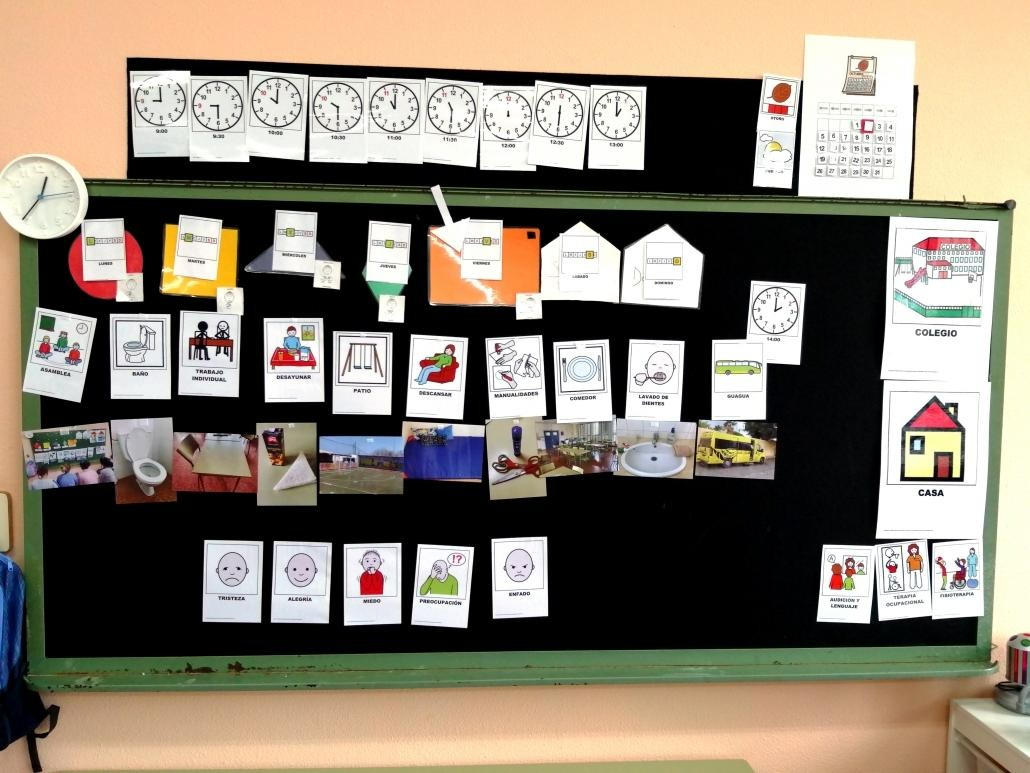
Orientation in a limited time with AAC. Activity objective
The main goal is to provide a clear visual scheme that allows the person to understand the sequence of events, manage the transitions between one activity and another, and orient themselves temporally within the day or a specific task.
Tools used
Several typical AAC supports can be used:
-
Activity strips (Schedule): Vertical Velcro supports where the symbols are placed in chronological order (from top to bottom).
-
Symbols and Real Photos: The combined use of graphic symbols (e.g. the bus, the house, the chair) and real photographs of the person or setting to make the message more concrete.
-
Routine Book: A ring binder that documents routines (e.g., “Alice gets on the bus,” “Alice sits in class”), useful for previewing and reviewing the day.
Carrying out the activity
-
Sequence Preparation: The educator prepares the visual strip by inserting the symbols of the planned activities (e.g. music, snack, gym).
-
Initial Communication: At the beginning of the session, you "read" the strip together to anticipate what will happen.
-
Monitoring and Transition: As an activity ends, its symbol is removed or moved to the "finished" pocket (visible at the bottom of the first image). This gesture visually marks the end of one period and the beginning of the next.
-
Personalization: As shown in the second image ("let's go to music", "let's make juice"), the use of real photos helps connect the symbol to the lived experience, facilitating recognition.
Benefits observed
-
Reduced disorientation: Knowing “what’s next” reduces unexpected stress.
-
Autonomy: The person can independently control the strip to know what to do.
-
Working Memory: Supports the retrieval of information about daily routines.
"I'm telling you about my dog Rudy ." Educational Objectives
-
Reading comprehension: Matching images and symbols to meaningful sentences.
-
Sentence Construction: Encourage the use of the Subject-Verb-Object structure.
-
Emotional engagement: Using elements of everyday life (your pet) to stimulate spontaneous communication.
Description of materials
The materials are structured to move from the concrete to the abstract:
-
Identity (Real Photo): A photo of the dog with the caption "MY DOG'S NAME IS RUDY." This serves as a reality check and motivation for the student.
-
Routines and Actions (CAA Symbols): A series of cards that describe the dog's characteristics and habits:
-
Nutrition: "eat kibble."
-
Game: "catch sticks" and "play with the ball".
-
Movement: "goes for walks."
Carrying out the activity in class
-
Presentation: We start from Rudy's real photo to identify the subject.
-
Association: The student is asked to choose a tile (e.g. "play with the ball") and associate it with Rudy's photo.
-
Sequence: You can arrange the tiles to create a "story of Rudy's day" (e.g. first he eats, then he goes for a walk, finally he plays).
-
Expansion: Using the symbols as a guide, the student can try to verbalize or indicate his or her desires or memories related to the dog.
Methodological Note: The use of standardized symbols (such as those shown in the images) alongside capitalized text facilitates the learning of functional reading even in the presence of cognitive difficulties or communication disorders.
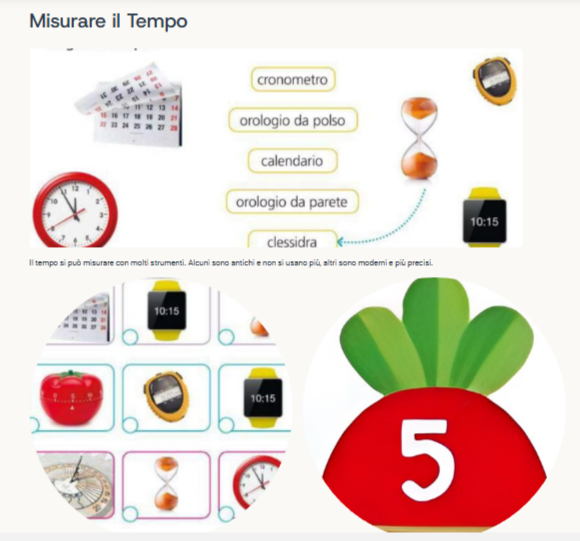
The Tools of Time . Educational Objectives
-
Identify measuring instruments: Recognize the different objects used to measure time (stopwatch, hourglass, clock).
-
Vocabulary-Object Association: Connect the correct term to the visual representation of the instrument.
-
Understanding different time scales: Distinguish between short-time (stopwatch) and long-time (calendar) tools.
Materials and Tools
From the analysis of the images, students will work with:
-
Analogue and Historical Instruments: Hourglass, sundial and wall clock.
-
Digital and Modern Tools: Smartwatch, digital watch and professional stopwatch.
-
Long-Term Planning: Paper Calendar.
-
Visual Timers: Kitchen timers (shaped like a tomato) and numerical indicators for the duration of an activity (e.g., the number 5).
Carrying out the Activity
-
Naming Phase: Using the label card, the student must draw lines or place the correct words next to the objects (e.g., match the word "hourglass" to the corresponding picture).
-
Functional Classification: The student is asked to group the tools according to their usefulness:
-
Which one do we use to know what day it is today? ( Calendar ).
-
Which one do we use to measure how long a race lasts? ( Stopwatch ).
-
Which one do we use to track play time? ( Timer or Hourglass ).
-
Practical Use (The Visual Timer): Use the image with the number "5" to graphically indicate the time remaining for a task, helping the student manage the wait or the end of an activity.
4. Materials
The selection of materials in an Augmentative and Alternative Communication (AAC) project is not an afterthought, but represents the construction of the very infrastructure through which students exercise their right to expression. As indicated in the course materials, AAC transforms the classroom environment into a "Talking Context," where each tool is designed to ensure cognitive accessibility and active participation.
Symbolic Systems and Communication Tables
The foundation of each material lies in the symbolic system adopted. The use of standardized sets such as ARASAAC or METACOM serves not only to illustrate concepts but also to provide a coherent visual grammar. Communication tables, whether paper or digital, must meet precise criteria of visual clarity and logical sequence. According to the ARASAAC guidelines, each pictogram must be strategically placed to facilitate eye scanning and pointing, following a syntactic structure that guides the student in sentence construction (Subject-Verb-Complement). These tools allow for the transition from purely solicited communication to one of commentary and social sharing.
Low-Tech Tools and the Value of the "Book of Self"
Communicative continuity is ensured by the use of low-tech tools, essential for their immediacy and portability. Among these, the "Book of Self 4.0" stands out, a dynamic and personalized document that serves as a "social passport" for students. Inspired by multidisciplinary models updated to 2024, this book allows students to present their strengths, their unique ways of expressing pain or pleasure, and the fundamental rules for communication partners (such as the importance of establishing eye contact and patiently awaiting a response). Alongside the Book of Self, the low-tech arsenal includes notebooks with symbols and iconic exchange systems such as PECS, which transforms the frustration of isolation into a concrete act of social interaction through the physical exchange of images.
High-Tech Innovation and Digital Media
Technological advances now offer high-tech solutions that enhance independent communication through speech synthesis. The integration of tablets equipped with specialized applications, such as MetaTalk , allows for the management of complex and configurable communication grids. These tools allow students to have an audible "voice" and navigate thousands of symbols organized by semantic categories. The strength of this high-tech tool lies in its dynamism: the tool can evolve along with the student's linguistic skills, moving from simple grids to advanced alphabetic or symbolic communication systems, always ensuring immediate auditory feedback that reinforces learning.
Educational Objects and Environmental Structuring
Finally, AAC must permeate everyday objects to make teaching a tangible experience. Creating pictogram dice, adapted memory games, and visual weekly timetables allows the concepts of cyclical time and spatial relationships to be expressed in playful activities. Organizing the environment by labeling spaces (doors, cabinets, drawers) with ARASAAC symbols helps create an inclusive climate where information is democratic and accessible to all. These materials, expertly integrated into the Lesson Plan, are not only disability-friendly aids but also learning tools for the entire class, promoting a culture of inclusion where "every voice deserves to be heard."
5. Instructions for Teachers
The success of an educational program based on Augmentative and Alternative Communication (AAC) depends not only on the quality of the materials produced, but also on the teacher's ability to "direct" an accessible environment. The following guidelines outline an approach that transforms classroom teaching into a participatory experience, where the teacher acts as a mediator between the student with complex communication needs and the rest of the school community.
Constant observation as a teaching compass
Every intervention must necessarily begin with constant and systematic observation. As highlighted in the clinical and teaching materials, it is impossible to design an effective lesson without first mapping the student's language, attention spans, and spontaneous productions. The teacher must listen not only to words, but to every communicative cue: facial expressions, eye movements, body movements, or pre -intentional sounds. This observation should not be limited to the initial phase of the year, but should be a recursive process: each lesson should be an opportunity to verify whether the tools (tables, symbols, high-tech aids) are still adequate or whether they need updating to monitor the student's evolving cognitive and relational profile.
Personalization
Personalization is at the heart of inclusive teaching. Teachers must be able to "disassemble" and "reassemble" lessons based on the severity of the disability, following the accessibility criteria defined in the reference documents:
-
Severe Disability: In this scenario, the lesson must focus on immediate, practical actions. Orientation to space and time must be supported by simplified visual agendas that reduce anxiety about the unknown. The teacher should focus not only on academic content, but also on the student's ability to make choices (self-determination) within the activity, using clear symbols and a logical sequence (Subject-Verb-Complement) that makes the task predictable and rewarding.
-
Profound Disability: Here, the teaching focus shifts to emotional well-being and basic sensory stimulation. The lesson becomes a "together" experience, where the teacher uses real objects and visual or auditory stimuli to maintain contact with reality. In this case, the "Book of Self 4.0" becomes an indispensable tool for the teacher, as it contains the keys to interpreting the signs of pain, pleasure, or fatigue that the student cannot express symbolically.
Building an Inclusive Climate: The Role of Communication Partners
A common mistake is to consider AAC a "private language" between the student and the special education teacher. On the contrary, true inclusion occurs when classmates are trained as competent communication partners. Teachers should promote the use of ARASAAC or METACOM symbols throughout the class, transforming them into a support tool for everyone (e.g., for learning foreign languages or for structuring texts). Engaging peers in the use of AAC avoids isolation and stigmatization, creating an environment where students with disabilities feel empowered to communicate because their code is understood by everyone. Activities like the UDA "Sara's Game" demonstrate how shared play can break down barriers: classmates learn to respect waiting times and value every response, transforming the class into a true "speaking community."
Monitoring and Evaluation with the "Six Hats"
Finally, the teacher must be able to evaluate not only the final result, but the communication process. The use of De Bono's Six Hats technique (present in the file "2 caa (1) (1).pdf" ) is highly recommended for post-lesson reflection. Inviting the class to reflect on "what we did" (facts), "how we felt" (emotions) and "what difficulties we encountered" (critical issues) allows for better calibrating subsequent lessons. This practice of constant self-assessment transforms limitations into creative resources, allowing the teaching staff to continuously innovate support strategies and ensure that the "bridge" built through AAC remains solid and accessible to every student.
6. Lesson Plan Template
Lesson Phase
Operational Objective
AAC Activities and Support
Adaptations for School Level
1. Anticipation (Setting)
Reduce anxiety and prepare for listening.
Using the Visual Agenda and the Activity Strip. Presenting the topic with a key symbol.
Infancy: Routine based on songs and real objects.
Primary: Daily visual timetable on the desk.
Secondary: Digital diary on tablet/iPad.
2. Cognitive Input (Explanation)
Present content in an accessible way.
Translating concepts into logical sequences ( subject + verb + complement ). Using concept maps into symbols.
Childhood: Storytelling with Modified Books.
Primary: Simplified texts with ARASAAC pictograms.
Secondary: Technical glossaries in CAA by key words.
3. Guided Practice (Activity)
Consolidate learning through doing.
Sorting, manipulation, or choice exercises using low-tech communication tables.
Childhood: Sensory play (inside/outside).
Primary: Word-symbol matching exercises.
Secondary: Reality tasks with AAC instructions.
4. Social Interaction
Promote an inclusive climate and peer tutoring.
Cooperative activities (e.g., Sara's Game ). Use of positive reinforcement and symbol-mediated speaking turns.
Childhood: Circle of Friendship.
Primary: Work in pairs with a shared table.
Secondary: Guided discussion with visual aids.
5. Verification and Evaluation
Monitor skills and well-being.
Pointing-based assessment grids. Using de Bono's Six Hats for self-assessment.
Childhood: Choice between "I like/I don't like".
Primary: Multiple choice test with pictures.
Secondary: Communication Skills Portfolio.
The anticipation phase and the emotional climate
Cognitive accessibility begins with predictability. You can't expect attention if the student doesn't know "what's going to happen." Using a visual planner isn't just a logistical aid, but also a guarantee of emotional well-being . Knowing that there will be a snack after the Italian lesson allows the student to invest their cognitive energy in the task at hand rather than managing uncertainty.
Cognitive input: simplify without trivializing
Visual Clarity rules typical of the ARASAAC/METACOM systems. The lesson is "segmented": long, subordinate clauses are transformed into simple, linear propositions. This approach benefits not only the student with disabilities, but also classmates with learning difficulties or non-native speakers, making the lesson truly universal.
Practice and Interaction: The Role of Partners
During the central phase, the teacher observes spontaneous productions . Here, the materials (high- or low-tech) must allow the student to be active. If the lesson focuses on spatial relationships, the student should be able to say "the ball is near me" using his or her chart. In this phase, the teacher promotes modeling , demonstrating how he or she would use symbols to communicate, thus validating the student's language in front of the entire class.
Evaluation and self-determination
Finally, assessment should not be a top-down judgment, but a moment of self-determination . Using the Six Hats technique, students (and the class) are taught to reflect on their own learning process. Asking "how did you feel?" (red hat) or "what was difficult?" (black hat) honors the student's voice, allowing them to actively participate in the review of their own educational plan (IEP).
Conclusions
The conclusions of this work allow us to reflect on how AAC represents the necessary "bridge" to transform isolation into connection and frustration into participation. The success of an educational plan is measured not only by the production of materials or tables, but also by the ability to create a cohesive "educational community," where teachers, communication partners, and classmates collaborate to eliminate all barriers.
The adoption of tools such as the "Book of Self 4.0" or visual planners demonstrates that continuity between school and home is essential to ensure that students find the same logical and visual code everywhere, facilitating their autonomy even in daily routines. Ultimately, AAC doesn't end its work within the school walls; it projects itself toward a broader "Life Project," aimed at progressive decision-making and social independence. Giving back a "voice" to those who cannot speak means recognizing each student's dignity and role within society, making inclusion not an abstract ideal, but a daily practice of freedom.
APPENDIX
-

Funded by the European Union. Views and opinions expressed are however those of the author(s) only and do not necessarily reflect those of the European Union or the National Agency for Community Programs in the Field of Education and Vocational Training (ANPCDEFP). Neither the European Union nor ANPCDEFP can be held responsible for them.
Copyright @eDash. All Rights Reserved by EnvyTheme