Gestural and Non-Verbal Communication Strategies
Gestural and Non-Verbal Communication Strategies
Abschnittsübersicht
-
Module 4: Gestural and Non-Verbal Communication StrategiesAbstract
This module explores and expands on the foundational role of gestural and non-verbal communication in educational and developmental contexts, particularly for neurodivergent individuals. Kinesics, proxemics, and haptics are the three foundations of gestural and non-verbal communication. First, underneath the umbrella of kinesics are the three categories of gestural communication (deictic, iconic, and emblematic), facial expressions, posture, and eye contact. Second, proxemics looks at the physical space between students and teachers as a means to mediate interactions. Third, haptics is the language of touch and how it can be used as an effective classroom management, communicative, and supportive tool.
Teaching non-verbal communication effectively relies on three things: using visual supports, modeling, and/or prompting. First, there is a hierarchy of visual support that ranges from concrete to abstract visual support. Second, there are three modeling strategies expanded upon: naturalistic, video, and peer modeling. Modeling allows children to learn by observing and repeating skills in real time. Lastly, prompting uses verbal and/or physical cues to guide a learner to acquire new skills.
The development of non-verbal interaction skills develops in a layering system, where each level of competence serves as a foundation for the next. Turn-taking, joint attention, and social routines are the three pillars that make up this development. Comparisons between neurotypical and neurodivergent non-verbal development of interaction skills are also expanded upon in each pillar to highlight the differences and how educators can translate them into a special education setting.
The multimodal integration of gestural and non-verbal communication in different settings plays a vital role in the speech and language development of neurodivergent individuals. Specific multi-modal integrations of gestural and non-verbal communication in pictograms, play, and home routines are expanded upon.
Foundations of Gestural and Non-Verbal Communication
1. Kinesics
Kinesics is the encompassing discipline that focuses on how body movements, postures, and gestures act as means of nonverbal communication. The following section will explore the essential components of kinesics.6
1.1 Gestural Categories and Functions
When used in conjunction with speech, gestures enhance communication and promote learning. According to research by Susan Goldin-Meadow, gestures do more than just reflect, though; they can actively expand a child’s knowledge by externalizing internal mental states onto the body, thereby lightening the learner’s cognitive load. Intentional gestures can be separated into three different functional types, which require distinct instructional approaches. The functional types are deictic, iconic, and emblematic gestures.6
1.1.1 Deictic Gestures (Indexing and Pointing)
Deictic gestures are context-dependent movements used to establish joint attention or to reference a physical entity. Deictic gestures act as a bridge between early language learning and development. For example, infants typically use pointing to refer to objects before they have the verbal labels for them. Educators can implement deictic gestures in the classroom to anchor new vocabulary (e.g., pointing to a specific picture while saying its name). 6
1.1.2 Iconic Gestures (Mimetic Depiction)
Iconic gestures are hand and body movements that mirror the concrete, physical content of speech. They “act out” the reference object and depict form or motion (e.g., moving your hands to mimic eating a sandwich or taking a phone call).6 Teachers can use iconic gestures to clarify abstract concepts or verbs. (e.g., illustrating “big” by spreading your hands far apart or by demonstrating what “bouncing” means by mimicking the motion of a bouncing ball)
1.1.3 Emblematic Gestures (Culturally Conventionalised Signs)
Emblematic gestures are ‘quotable’ gestures that represent a standardized, culturally specified meaning and can often stand alone without speech. These gestures are learned through cultural transmission and illustrate specific verbal messages (e.g., “thumbs up” for showing approval).
Emblems can serve as efficient classroom management tools, serving as “silent signals” that reduce instructional interruptions (e.g., putting an index finger over your mouth to signal to the class it is time to stop talking). It is important for teachers to explicitly teach the meaning of specific emblems in the classroom to ensure all of the students have an equal understanding of the gesture.6
1.2 Facial Expressions
Facial expressions are a key part of non-verbal communication. Most of the emotional information expressed in the face is carried in the shape of the eyebrows and the mouth.7 Using facial expressions in the class can show a level of satisfaction or the need for correction for the student. For example, if a student says the wrong answer, instead of saying “wrong” or “incorrect,” the teacher can frown (without saying a word), and this can communicate that the student got the answer wrong. Doing this can protect the student’s pride and limit verbal correction done by the teacher.7 For students with disabilities, it is important to understand each student's facial expressions and the emotions associated with them. A student may express a certain emotion with their facial expressions that may not be conventionally associated with that particular emotion. This can also be used as a learning opportunity; teachers can educate students about the differences in the meanings of facial expressions to create a more standard interpretation of emotions.8
1.3 Posture
A teacher's posture serves as a primary signal for approachability and can stimulate the students' positive attitude.7 For example, when a teacher is standing with the shoulders back and in an open position, this can signal confidence and control (which helps prevent disruptive behaviors in the classroom). When a teacher gets on a student’s level (e.g., when getting on one knee to talk to a young primary student or kneeling to be eye-level with a student when they are in their desk), it can make the student feel more comfortable and reduce the power imbalance felt in the classroom. This, in turn, can promote more dialogue and encourage a positive classroom environment. A student’s posture is also important to note in the classroom. It can signal attentiveness and focus during class. Upright posture is associated with better focus and school performance in students.7
1.4 Eye Contact
Eye signals can give us insight into the student’s behaviors and inner thoughts. Looking around allows the teacher to consider the attention and understanding of the classroom as well as use it as a classroom management tool. A teacher can look at students intentionally to measure cues of boredom and attention. A teacher can also use eye contact to criticize the students’ inattentiveness and bad behavior.7
The nuance of eye contact is important to consider. In Western educational culture, direct eye contact is considered a sign of attentiveness, focus, and respect. In other cultures, that may be the opposite. It is important to evaluate the cultural perspective of students and teachers when assessing eye contact behaviors. It is important to take into account people’s age, ability, gender, social hierarchy, or other contextual factors that influence how people use eye contact..8 For example, many students who are on the autism spectrum may find it difficult to maintain eye contact.
2. Proxemics
Proxemics in the context of a classroom is in reference to how teachers and students use the classroom space and interpersonal distance to mediate interactions. Proximity control strategies involve intentionally reducing the distance between a teacher and a student to redirect behavior without the need for verbal reprimand.9
Research indicates that a teacher’s positioning is a powerful tool that can be used to influence engagement, motivation, and visual involvement. Students who are closer to the teacher report significantly higher levels of motivation and academic engagement. Effective movement around the classroom can help maintain control and reduce disruptive behavior.9 Data also shows that students who are most visually involved with the teacher's instructions are 1.20 to 3.70 meters away from the teacher.10
Personal distance has a variety of things to consider culturally. It is important to consider cultural dimensions and the individual relationships in the classroom (one student may be comfortable with close personal space, while another may not).8 For neurodivergent students in particular, it is important to balance the need for proximity with respect to the student’s sensory boundaries.
3. Haptics
Haptics is the language of physical touch and can be used as a communicative and supportive tool. In special and early education, touch can reinforce verbal messages (e.g., a teacher’s gentle touch on the shoulder while speaking can help a child pay attention to the message and deepen understanding).7 Touch is linked to the release of oxytocin, which can promote feelings of security and trust. It can also convey comfort, empathy, and encouragement and, in turn, help create a positive relationship between students and teachers. Conversely, it can be associated with its connection to violence and abuse as well. The effectiveness of haptics depends heavily on the relationship, cultural norms, and setting, so teachers should be aware that it is extremely context-dependent.7
Teaching Non-Verbal Communication Effectively
Visual supports, modeling, and prompting are key strategies for teaching nonverbal communication in the classroom. Visual aids should be correlated to the student’s cognitive level to maximize effectiveness. Modeling, on the other hand, makes it easier for students to learn new communication skills. Modeling allows students to observe functional examples in meaningful contexts. Lastly, prompting is an individualized, gradual support system that promotes autonomy and guides learning.
1. Visual Supports
Visual supports are permanent, communicative items such as objects, photographs, signs, or pictures. Visual aids include photographs, pictograms, objects, or signs that remain accessible to the learner regardless of whether verbal communication is present. Visual aids encourage participation, facilitate understanding and autonomy of the student, and allow teachers to set individualized goals in the areas of play, communication, and social skills.25 Visual supports should be considered primary, not supplementary, instruments for establishing structure and routine in the classroom. 1,2
1.1 The Hierarchy and Utility of Visual Support
Children learn to understand that a visual item represents a real-world object, action, or concept in a systematic sequence. It is the educator’s responsibility to correlate the visual tool to the child’s current cognitive stage. By doing this, it can help ensure the message is better received and understood. The hierarchy expanded below follows a progression from the most concrete to the most abstract types of visual supports, along with ways they can be applied in the classroom. 1-3
1.1.1 Real Objects—Concrete
The most literal level. The item is a physical object. Examples are tactile symbols/objects of reference. (e.g., using a physical ball to indicate outdoor play)
Small World Objects—Representational
Miniatures of real objects. (e.g., using miniature items such as a toy bus to represent a student's community to school)
Photographs—Realistic
High-resolution images of specific items or people the student interacts with. (e.g., a photo of a student’s mother)
Pictures and Symbols—Symbolic
Colored icons or standardized symbol sets. (e.g., PECS board or icons on an AAC program)
Line Drawings—Abstract
Simplified icons that remove irrelevant visual detail, often reducing sensory overload. (e.g., black and white line drawings of icons or symbols)
Words and Phrases—Literacy Based
Written text. Can be paired with symbols to scaffold early reading and vocabulary development. (e.g., moving from single-word phrases to eventually whole phrases and sentences)
1.2 Importance of Correlating Visual Tools to Cognitive Level
Correlating the correct visual tool to the child’s cognitive level is critical to ensuring the student receives the most benefits from the visual supports. If an educator uses a support that is too abstract for a child, the child may not understand the concept, and this could lead to frustration or behavioral challenges. Conversely, using supports that are too concrete for a child who can understand a more abstract concept can hinder their transition to more advanced language and literacy skills.4
It is also important to understand the child’s receptive vs. expressive speech and language levels. A child might have high receptive levels (e.g., understand information via photographs) but may still require real objects to express their needs effectively. Educators can use assessments, such as the ESDM Curriculum Checklist (a play-based intervention), to identify a child’s current “Zone of Proximal Development.” Doing this can help the educator identify the gap between the students' gap between current skills and their potential. The assessment also helps facilitate the creation of 2-4 target goals in areas like communication, play, social skills, and imitation to help guide play-based interventions.4
2. Modeling
Modeling is the most powerful method for teaching new gestures, as children learn through frequent repetition in natural contexts. Children can learn by observing and repeating in real life/time, making modeling a highly effective strategy for teaching new skills.25 Modeling is the most powerful method for teaching new gestures, as children learn through frequent repetition in natural contexts. Three modeling strategies are naturalistic, video, and peer modeling. Nauratlitic modeling follows the child’s interest in their environment, enhancing social communication and daily living skills. Video modeling shows the desired behavior to teach functional and symbolic play/behaviors. Peer modeling utilizes peers to reinforce behaviors in a social or functional setting. In addition to modeling, prompting is an effective tool that consists of giving verbal or physical cues to guide learning. When promoting, it is important to fade levels of support and utilize wait times to develop and enhance independence. These prompting techniques help develop social, communication, and autonomy skills and adapt to the needs of each student. 14-17, 26
2.1 Naturalistic Modeling
The naturalistic modeling strategy is a combination of practices based on applied behavior analysis principles. Naturalistic modeling encourages skill generalization in real-world scenarios and is taught in a child’s natural environment (e.g., play, home, and school). Modeled actions are demonstrated in real-time by teachers, allowing the child to see and then imitate the behavior in a natural context. An important consideration when using this modeling approach is allowing it to be child-led. The teacher must follow and incorporate the child’s interests and motivations (e.g., using a child’s favorite game).11 This approach is especially effective for developing social communication and daily living skills.
2.2 Video Modeling
This intervention involved students watching a video of a modeled behavior. The video model should be accompanied by prompts (e.g., directions to pay attention to certain parts of the video), narrative (e.g., verbal or written statements about the depicted behavior), and/or reward systems. Traditional, video self-modeling, and point-of-view modeling are three examples of different kinds of video modeling that can be used. First, in traditional video modeling, the video shows another person performing a desired skill. Second, in video self-modeling, the video shows the individual performing a desired skill. And lastly, the point-of-view modeling shows a video that shows a desired skill from the individual’s point of view. Video modeling has proved to be supportive for autistic individuals and can be used to teach functional and symbolic play actions to children with ASD.12
2.3 Peer Modeling
Peer modeling is a modeling technique that involves using peers to model the behavior, not the adult. Neurodivergent children often find it easier to relate to their peers rather than their teachers. Peer modeling is very effective in modeling appropriate social behaviors and allows the student to internalize social norms more organically. Peer models can also serve as reinforcement for certain behaviors (e.g., having a peer verbally praise or correct a behavior).13 It is important that educators train and regularly provide feedback to selected peer models to help ensure that they are serving as efficient models.
3. Prompting
Prompting is the use of verbal and/or physical cues to help guide a learner to acquire new skills. The prompt hierarchy helps students gain independence, learn new skills, and generalize skills across different settings and people.14
The most intrusive prompting is full physical prompting. This prompt should be used rarely and is typically used when teaching a new skill. The hand-under-hand method is recommended when full physical prompting is necessary. In contrast to the hand-over-hand method, the learner has their hand over the educator’s hand. This promotes greater independence and autonomy.The goal of using the prompting hierarchy is to get the child to accomplish the task independently without needing a prompt. It is important to note, though, that some students may never reach this level, which is okay, and it is critical to meet the student where their needs are.16
There are two strategies to help tackle the question “How much should I prompt?” These are the least-to-most intrusive approaches and the most-to-least intrusive approaches. The least-to-most approach is designed to increase learning. It begins with minimal assistance and then increases the level of prompting based on the individual’s needs. The most-to-least approach is designed to increase independence. This approach begins with the most support, then prompts are reduced over time as the learner becomes more proficient.15
Time delay is an important method to employ regardless of the approach. The two time-delay methods are constant and progressive time delays. Constant time delay is where there is a fixed interval between the instruction and the prompt (normally 3-5 seconds). An example of this is if a teacher is teaching a child to identify a picture of a cat. The teacher instructs with a phrase like “touch the cat.” The teacher then waits 3 seconds; if the student does not touch the cat, the teacher then points (or any other form of prompting) to the cat after the 3 seconds. Progressive time delay is a procedure that gradually increases the wait time between the instruction and the prompt. After each trial, the teacher gradually increases the delay (up to 10 seconds). If the learner can do the task with two consecutive zero-second time delays, they are ready to use the constant or progressive time delay approach.17
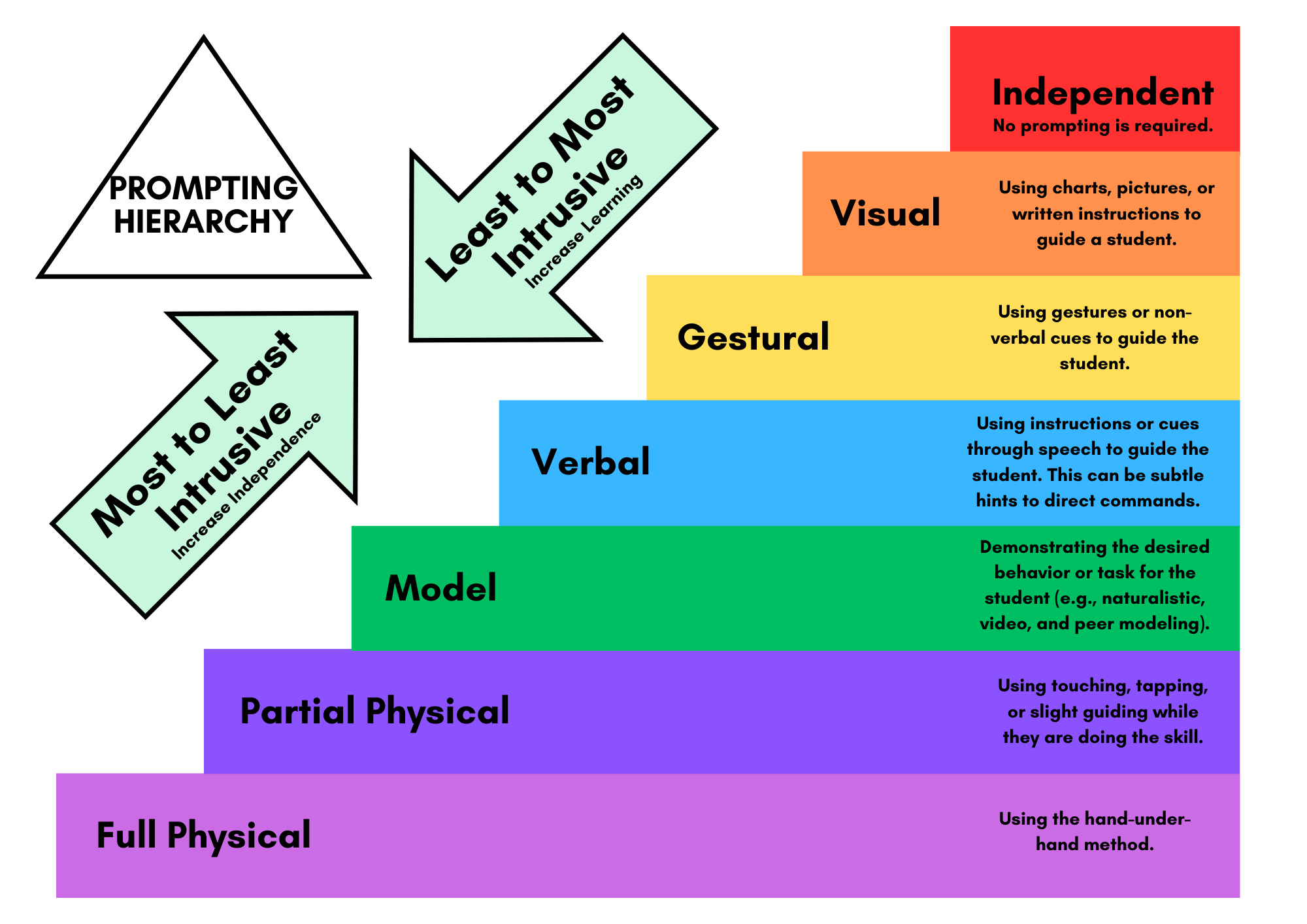
This is a graphic explaining the levels of the prompting and the two possible approaches. 14-16
Development of Non-Verbal Interaction Skills in Neurotypical and Neurodivergent Individuals
The development of non-verbal interaction skills in neurotypical and neurodivergent individuals does not occur in isolation but in a developmental cascade where each level of competence serves as a foundation for the next. This process is based on three essential pillars: turn-taking, joint attention, and social routines.
1. Turn-Taking
Turn-taking begins with protoconversations, which take place before verbal conversations. Protoconversations emerge in early infancy (2-4 months old). They are nonverbal exchanges of sounds, movements, and eye contact. The infant establishes the rhythmic foundation of a turn in conversation and learns to wait for a caregiver’s sound before making their own. From 9 to 12 months, neurotypical infants begin to use multimodal signaling, where they coordinate gaze, verbal output, and sound together.22 In general, a typical profile of turn-taking is multimodal and involves more than just speech (e.g., visual cues, body language, and social reciprocity). During the first year, neurotypical infants also learn to use “anticipatory gazes” to check for a reaction from their task (verbal or non-verbal task). Adult conversation typically has a gap of around 200 ms between turns, and this can be reflected in infants as gaze shifts to signal they are ready for a response.20
Speed and prediction of turn-taking are often what seem to be notable differences between neurotypical and neurodivergent students. A neurotypical student often “pre-plans” their turn during the 200 ms window, and the neurodivergent student may still be processing the first half of what the other communication partner said during that window. This leads to longer pauses or “mistimed” interruptions seen in conversations with neurodivergent students. Overall, neurodivergent timing in turn-taking is extremely context-dependent. With familiar communication partners, like a caregiver, neurodivergent children often mirror the tempo of the conversation and the predictability of their parents. With unfamiliar partners like peers or teachers, the timing has a breakdown, and students can struggle to adapt their tempo to a new person’s conversational rhythm. This can be seen as a student being able to take typical conversation turns with a 1-on-1 aide but struggling to do so in a group classroom discussion.21
2. Joint Attention
Joint attention begins developing at 6 months. It refers to the human capacity to coordinate attention between communication partners and an object/event. It is a triadic relation and can be seen in infants as infant ↔ caregiver ↔ object. It is a foundational skill for the acquisition of language, social understanding, and learning. It also serves as a precursor to social cognition (e.g., theory of mind). The skill of responding to joint attention (RJA) emerges from 6 to 9 months in typically developing children. This is the ability infants show to follow another’s gaze or gestures. The skill of initiating joint attention (IJA) emerges by 10-12 months. The child can use eye contact and gestures to actively direct a partner’s attention. 18
In autism, there are greater impairments in IJA than RJA.18 This correlates to the idea that the greatest difference in communication between children with autism and neurotypical children is the difference in social quality and intent of that communication.19
Joint attention is instrumental and declarative (sharing for the sake of sharing). The main ways this can be observed are through the “core deficit theory” and the difference in eye gazing. The Core Deficit Theory (Mundy) shows that students with autism show greater strength in gestures to request objects (instrumental) than in gestures to share interest (social).18 In terms of gaze differences, neurodivergent students tend to focus more on the object involved in the triad of joint attention rather than the person’s eyes (overselectivity). It can be inferred that people with autism use gestures and other communicative acts to serve as behavior regulation (requesting or protesting) rather than for social interaction or joint attention.19
3. Social Routines
Around 9-12 months is when prelinguistic skills begin to emerge, and communication becomes more intentional and symbolic. During this time, infants begin to use nonverbal communication like facial expressions, eye gaze, vocalizations, and gestures to share attention, interact, and request. This time period sets the stage for the upcoming burst of language development.22 Social routines can be referred to as “scripts.” A social routine becomes a script when the child is familiar with an activity (like meal or bath time) enough to predict what is happening next (e.g., peek-a-boo). Scripts are internalized social knowledge that stores information about social roles and expected behaviors. The predictability of the script acts as a means to scaffold because the child’s cognitive load is lighter, and it allows them to focus on communication rather than the task itself.23
Predictability is what neurodivergent people tend to gravitate towards. Which, in turn, helps them avoid overstimulation and anxiety. That being said, scripts (the predictability of them) often serve as a vital coping mechanism for neurodivergent people and create zones of familiarity. Because of this, when neurodivergent people are in unfamiliar social routines, or there is a “detour” in the script (the script becomes unfamiliar due to a disruption), it can be overwhelming for them, and they may face a communication breakdown.24 This can commonly be seen in a school setting when students become overwhelmed with changes that happen in the transitions between classes or when class routines are disrupted.
Practice and Multimodal Integration of Gestural and Non-Verbal Communication
Multimodal integration of gestural and non-verbal communication in pictograms, play, and home routines plays a vital role in the speech and language development of neurodivergent individuals. By prioritizing the use of non-verbal and gestural communication across various environments, we can bridge the gap between internal thought and external expression. This fosters both autonomy and social development of the child.
1. Use of Pictograms in Non-Verbal Communication
Pictograms, also known as icon or symbol sets, are simple graphic representations of real-world objects, concepts, and actions. They are multimodal in nature, as they combine visual, textual, and contextual modes to convey complex information.27 They are essential to nonverbal communication and provide access for people with disabilities.
An aided augmented input process is what educators can do to foster understanding of the pictograms and their correlation to real-world objects and reinforce correct responses. These processes involve natural communicative and social routines (e.g., toy play, engagement, and interaction). This is a modeling strategy where educators verbally model language while simultaneously pointing to a coordinating pictogram on a board or device. In a study done by Zurita Diaz,27 after using aided augmented input in 45 intervention sessions and three evaluations, it was found that using ARASAAC pictograms showed greater improvements in the students' expressive and receptive communication, behaviors, and social skills. Other high-iconicity symbol sets were used (Mi Estuche de Pictos) and showed positive results, but the ARASAAC stood out because of its accessibility, customization, and iconicity. ARASAAC is the standard, government-funded pictographic system in Spain that is free and integrated into many apps. Based on this study, it can be implied that other AAC symbol sets that have those same qualities in other countries using the aided augmented input strategy will be equally effective in improving expressive and receptive communication, behaviors, and social skills.27
2. Multimodal Integration of Non-Verbal Communication with Play
Playtime does not have to rely on verbal output. There are many ways to play using non-verbal communication. Play-based, non-electronic games for non-verbal communication can integrate tactile, kinesthetic, visual, auditory, and proprioceptive/vestibular modalities. Non-verbal games bridge communication gaps by utilizing facial expression, body language, and physical objects to create shared meaning.29 Some examples of non-electric and non-verbal games are mirror/copy games, non-verbal charades/acting, construction and collaborative play, movement games, sensory bins/art, and picture/card games.
Multimodal play can also serve as a way to regulate sensory responses of neurodivergent students. Heavy work/proprioceptive activities, such as pushing, pulling, and lifting, are grounding activities that increase bodily awareness of the student. Implementing activities for certain regulatory needs during playtime can be beneficial for the regulation of neurodivergent students in school. Calming movements such as swinging, slow stretching, and rocking reduce over-arousal and promote relaxation of the student. Sensory tools such as fidgets, visual timers, and weighted blankets enhance self-regulation and focus for the child.30
3. Combining Non-Verbal Communication and Home Routines
Utilizing gestures, visual aids, and AAC in home routines fosters independence, reduces frustration, and promotes language development. Prompting methods like using visual cues or gestures in the home can clarify expectations for daily tasks/routines (e.g., having step-by-step signs for getting dressed, taking a shower, and brushing teeth). This, in turn, allows children to complete the tasks over time with less prompting/adult assistance, promoting autonomy and independence. Overall, breaking down home routines into smaller and more manageable steps reduces the feeling of being overwhelmed for the child and promotes independence.31
Morning, mealtime, and hygiene routines are great opportunities to integrate multimodal communication while at home. Using AAC tools (either low or high tech) alongside gestures and prompting promotes device usage and language development outside of an educational setting. Strategies to promote language development in home routines are the +1 law, using repetition and intonation, and avoiding asking questions. The +1 law is speaking one level more advanced than your child while at home. For example, if your child is non-verbal, then try to communicate in short, one- or two-word phrases and gradually increase into complete sentences. The second strategy is using repetition and intonation. Focus on specific words that you want to work on by emphasizing that word or phrase with different intonation. Repetition is also important in the integration. The last strategy is to avoid asking questions. This lightens the mental load and interest in the activity. By incorporating these multimodal techniques into household routines, the routines themselves become more accessible, predictable, and engaging.31
Bibliography
-
National Council for Special Education. Using Visuals to Support Communication. Government of Ireland; 2021. https://ncse.ie/wp-content/uploads/2021/06/Using-Visuals-to-Support-Communication.pdf
-
Visual Supports» Center for Autism and Related Disabilities» College of Medicine» University of Florida. https://card.ufl.edu/resources/visual-supports/
-
Information Taken and Adapted from the National Autistic Society Website (2018); Visual Supports. https://www.esht.nhs.uk/wp-content/uploads/2021/02/Visual-Supports.pdf
-
The Importance of Assessment for Children with Autism Spectrum Disorder. www.playandlearntogether.com.au. https://www.playandlearntogether.com.au/play-blog/the-importance-of-assessment-for-nuerodivergent
-
Kabot S. Support You Can See (and Feel): Teaching Children with Autism | NAEYC. Naeyc.org. Published 2019. https://www.naeyc.org/resources/pubs/tyc/oct2019/teaching-children-autism
-
Goldin-Meadow S. How Gesture Promotes Learning Throughout Childhood. Child Development Perspectives. 2009;3(2):106-111. doi:https://doi.org/10.1111/j.1750-8606.2009.00088.x
-
Ghorzang S, Omari MS, Yahyazai M. The Importance Of Nonverbal Communication In Teaching. Elementary Education Online. 2021;20(6):3043-3051. https://ilkogretim-online.org/index.php/pub/article/view/4801/4658
-
Nonverbal Communication in Diverse Classrooms: Intercultural Competence Considerations for Supporting English Learners With Significant Cognitive Disabilities. Wisc.edu. Published 2025. https://wida.wisc.edu/resources/research-brief/nonverbal-communication-diverse-classrooms-intercultural-competence
-
Martinez-Maldonado R, Schulte J, Echeverria V, Gopalan Y, Shum S. Where Is the Teacher? Digital Analytics for Classroom Proxemics. https://martinezmaldonado.net/files/JCAL_Where%20is%20the%20teacher_main%20manuscript%20(FINAL).pdf
-
Wang Mengke, Long T, Chen Z, Wu X, Shi Y, Xu L. Investigating the Interaction Types and Instructional Proxemics in Information Technology Enhanced Exemplary Lessons. The Asia-Pacific Education Researcher. Published online February 16, 2023. doi:https://doi.org/10.1007/s40299-023-00714-4
-
Schreibman L, Dawson G, Stahmer AC, et al. Naturalistic Developmental Behavioral Interventions: Empirically Validated Treatments for Autism Spectrum Disorder. Journal of Autism and Developmental Disorders. 2021;45(8):2411-2428. doi:https://doi.org/10.1007/s10803-015-2407-8
-
Wilson KP, Valazza E, Price C. Video Modeling to Support Social Communication Goals of Autistic Adults: A Tutorial. American Journal of Speech-Language Pathology. 2024;33:1-17. doi:https://doi.org/10.1044/2024_ajslp-23-00479
-
The Role of Peer Modeling in Social Skills Development | Intellistars - ABA Therapy. Intellistarsaba.com. Published 2025. https://www.intellistarsaba.com/blog/the-role-of-peer-modeling-in-social-skills-development
-
Understanding prompt hierarchy in ABA. Magnetaba.com. Published 2025. https://www.magnetaba.com/blog/understanding-prompt-hierarchy-in-aba
-
ABA HT. The Prompt Hierarchy. How to ABA. Published October 31, 2017. https://howtoaba.com/the-prompt-hierarchy/
-
Bermudez H. Utilizing the Prompting Hierarchy - Simply Special Ed. Simply Special Ed. Published August 6, 2025. https://www.simplyspecialed.com/utilizing-the-prompting-hierarchy/
-
Sam and AFIRM for Paraeducators team. (2024). RESOURCE PACKET: TIME DELAY: INTRODUCTION & PRACTICE AFIRM for Paraeducators; UNC Frank Porter Graham Child Development Institute Autism Focused Intervention Resources & Modules for Paraeducators. https://afirm.fpg.unc.edu/wp-content/uploads/Time-Delay-Introduction-Practice-Packet-Sam-et-al-Updated-2024.pdf
-
Mundy P, Newell L. Attention, Joint Attention, and Social Cognition. Current Directions in Psychological Science. 2007;16(5):269-274. doi:https://doi.org/10.1111/j.1467-8721.2007.00518.x
-
Bruinsma Y, Koegel RL, Koegel LK. Joint attention and children with autism: A review of the literature. Mental Retardation and Developmental Disabilities Research Reviews. 2004;10(3):169-175. doi:https://doi.org/10.1002/mrdd.20036
-
Levinson, S. C. (n.d.). Turn-taking in Human Communication – Origins and Implications for Language Processing. Trends in Cognitive Sciences; Cell Press; CellPress. https://pure.mpg.de/rest/items/item_2193297_6/component/file_2231556/content
-
Cox C, Riccardo Fusaroli, Nielsen YA, et al. Social Context Matters for Turn‐Taking Dynamics: A Comparative Study of Autistic and Typically Developing Children. Cognitive Science. 2025;49(10). doi:https://doi.org/10.1111/cogs.70124
-
Bradshaw J, McCracken C, Pileggi M, et al. Early social communication development in infants with autism spectrum disorder. Child Development. 2021;92(6):2224-2234. doi:https://doi.org/10.1111/cdev.13683
-
Stewart J. Child’s Talk, by Jerome Bruner. Amazon. Published online January 1, 2007. https://www.academia.edu/41476688/Childs_Talk_by_Jerome_Bruner
-
Why Autistic People Prefer Routine And Structure. Simply Psychology. Published August 5, 2025. https://www.simplypsychology.org/autism-and-routine.html
-
Howard, Jill & Dawson, Geraldine. (2020). The Early Start Denver Model (ESDM). DOI:10.1007/978-3-030-46295-6_23
-
1.Quill KA. Instructional Considerations for Young Children with Autism: The Rationale for Visually Cued Instruction. Journal of Autism and Developmental Disorders. 1997;27(6):697-714. doi:https://doi.org/10.1023/a:1025806900162
-
Zurita Díaz AJ, Couceiro Figueira AP, Calleja Reina M. Comparison of the effectiveness of ARASAAC pictograms and commercially available pictograms in children with autism spectrum disorder and complex communication needs. Revista de Investigación en Logopedia. 2026;16(1):e101612. doi:https://doi.org/10.5209/rlog.101612
-
Gray S. What are Pictogram Signs and Why Should I Use Them? - Signbox. Signbox. Published May 3, 2024. https://www.signbox.co.uk/pictogram-signs/
-
Play Ideas That Don’t Rely on Spoken Words | Nonverbal Fun. Apex Social US. Published 2025. Accessed February 13, 2026. https://apex-social.org/us/play-ideas-that-dont-rely-on-spoken-words/
-
How to Use Sensory Techniques to Support Children in Therapy. Buildingblockstherapy.org. Published 2025. https://www.buildingblockstherapy.org/blog/how-to-use-sensory-techniques-to-support-children-in-therapy
-
The Benefits of Integrating ABA Strategies into Daily Routines | Intellistars - ABA Therapy. (2025). Intellistarsaba.com. https://www.intellistarsaba.com/blog/the-benefits-of-integrating-aba-strategies-into-daily-routines
Acknowledgments
Google Gemini AI was used in the collection of sources for this module.
-
Funded by the European Union. Views and opinions expressed are however those of the author(s) only and do not necessarily reflect those of the European Union or the National Agency for Community Programs in the Field of Education and Vocational Training (ANPCDEFP). Neither the European Union nor ANPCDEFP can be held responsible for them.
Copyright @eDash. All Rights Reserved by EnvyTheme